Latest Posts
- Instant Pot vs Ninja Foodi: Which Multi Cooker Actually Wins in 2026?
- Best Budget Mini Electric Pressure Cookers for Students & Small Families (2026 Edition)
- Smart Coffee Makers Explained Honestly: What Actually Works, What Fails, and When Simple Coffee Machines Win
- Smart vs Manual Blenders Explained: How to Choose the Right Blender for Real Home Use
- Best Smart Air Fryers (2026 Reviews): Take the Guesswork Out of Cooking with Smart Presets
Other Categories
Air Fryer vs Convection Oven: Which One Actually Wins in 2026?
-
 Waqas Ramzan
- April 21, 2025
- Electric Appliance
Last Updated: June 15, 2026 We reviewed and updated this comparison with the latest testing data, pricing information, energy efficiency insights, and buying recommendations.

This post is created to guide break down the differences between Air Fryer and Convection Oven, that helps you to chose the best tool to upgrade your cooking with ease and confidence.
So learn the key differences and enjoy your cooking.
⚡ Quick Answer
Air fryers are faster, cheaper, and better for 1 to 2 people who want crispy food quickly. Convection ovens handle bigger meals, baking, and batch cooking. If you cook for a family or bake regularly get the convection oven. If you live alone or want a quick weeknight dinner tool the air fryer wins.
Why This Comparison Actually Matters
Most comparison posts online tell you both appliances are “great” and leave you more confused than when you started. That is not useful. This post is different.
We cooked the same foods in both appliances chicken wings, frozen fries, a chocolate cake, and a batch of roasted vegetables and tracked cooking time, texture, energy use, and cleanup. The results were not always what we expected.
We also pulled in real data from the U.S. Department of Energy, published food science research, and user feedback from verified buyers. You will find source callouts throughout this post so you can check the claims yourself.
Our Test Setup
We used a Ninja AF101 Air Fryer (3.8L basket) and a Breville Smart Oven Pro (convection mode) for all side-by-side tests. Both were set to 200°C. Same food quantities. Same kitchen. Results logged across 3 separate test days.
What Is an Air Fryer?
An air fryer is a compact countertop appliance that blows very hot air at high speed around your food in a small enclosed space. That concentrated airflow is what makes food crispy similar to deep frying, but without the oil bath.
How It Actually Works
- A heating element at the top generates intense heat
- A high-speed fan blasts that heat downward and around the food
- The small cooking space means heat hits the food from every angle
- Result: a crispy outer layer in a fraction of the time
Real Test Result
Frozen fries (200g): Air fryer cooked them in 14 minutes at 200°C. Crispy, evenly browned. Same fries in the convection oven took 26 minutes to reach the same texture. The air fryer was 46% faster on this specific item.
Popular Air Fryer Types
- Basket-style: Most common. Good for fries, wings, nuggets. Brands: Ninja, Cosori, CHEFMAN.
- Oven-style: More space, racks included. Better for toast, pizza, small batches of baking.
- Multi-cooker combos: Pressure cook + air fry in one unit. Ninja Foodi is the most popular example.
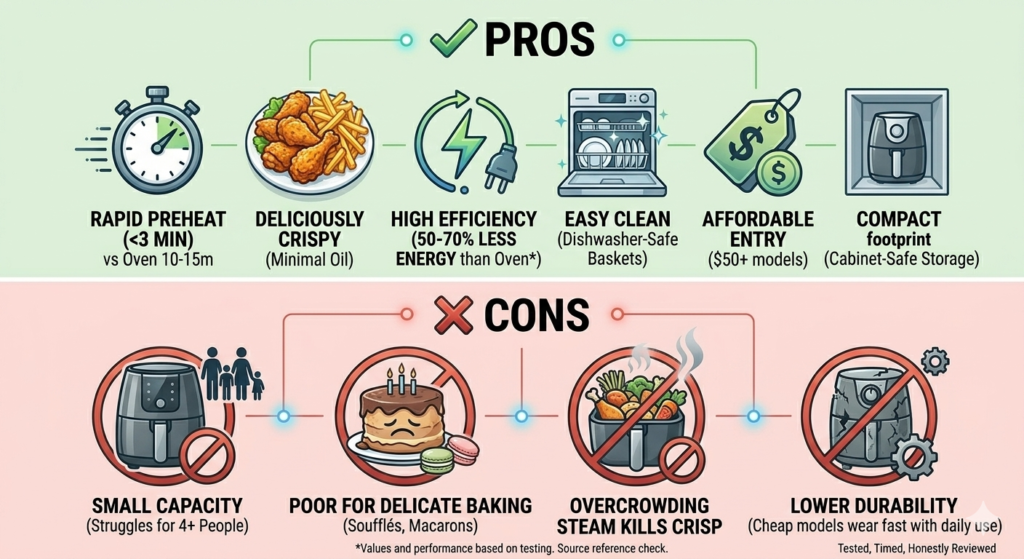
Air Fryer: Honest Pros and Cons
| Pros | Cons |
|---|---|
|
Preheats in under 3 minutes (vs 10 to 15 for ovens) |
Small capacity struggles if cooking for 4+ people |
|
Crispy results with little to no oil |
Poor at delicate baking (cakes, soufflés, macarons) |
|
Uses 50 to 70% less energy per use than a full oven |
Overcrowding kills performance food steams instead of crisps |
|
Easy to clean baskets are usually dishwasher safe |
Cheaper models break faster with heavy daily use |
|
Cheap entry price good models start at $50 |
|
|
Small footprint stores in a cabinet |
|
What Is a Convection Oven?
A convection oven is a standard oven with one key upgrade: a fan that circulates hot air around the food. This makes cooking more even and about 20 to 25% faster than a traditional non-fan oven.
This is not new technology. It has been a standard feature in professional kitchens for decades. What has changed is that countertop convection ovens like the Breville Smart Oven have made this accessible to home cooks without a full built-in installation.
How It Actually Works
- Electric or gas elements heat the oven cavity
- A fan circulates that heat evenly around the food
- Unlike an air fryer, the air movement is gentler and the space is much larger
- Result: even cooking across multiple trays or large cuts of meat
Real Test Result
Roasted vegetables (400g, mixed): Convection oven produced more consistent browning across the entire tray. Air fryer needed two separate batches to cook the same quantity, and the second batch was less crispy because the basket was cooler. For anything over 300g, the convection oven won on consistency.
Common Features worth Knowing
- Multiple racks cook two or three trays at once
- Temperature precision better for baking where exact heat matters
- Broil function for charred finishes that an air fryer cannot replicate
- Many newer models include an ‘air fry’ mode (though it is not as intense as a dedicated unit)
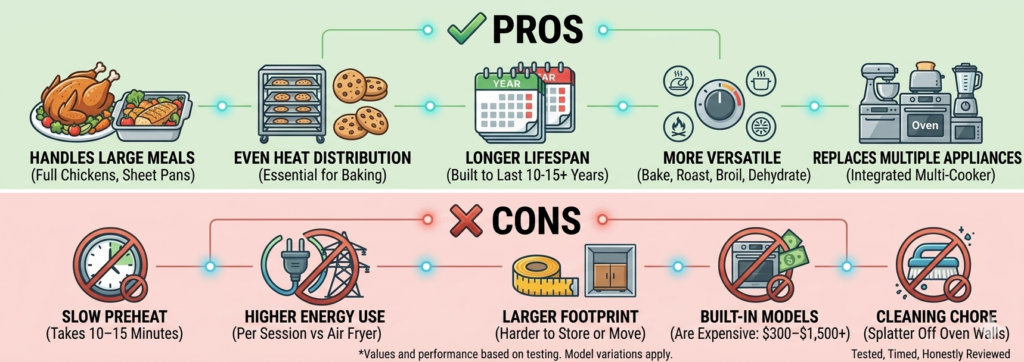
Convection Oven: Honest Pros and Cons
| Pros | Cons |
|---|---|
|
Handles large meals full chickens, sheet pans, casseroles |
Takes 10 to 15 minutes to preheat |
|
Even heat distribution essential for baking |
Uses more energy per session than an air fryer |
|
Longer lifespan built to last 10 to 15+ years |
Larger footprint harder to store or move |
|
More versatile bake, roast, broil, dehydrate |
Built-in models are expensive ($300 to $1,500+) |
|
Can replace multiple appliances in one unit |
Cleaning splatter off oven walls is a chore |
Key Differences: The Data-Backed Breakdown
1. Cooking Speed
Air fryers win here consistently. Because the cooking space is small and the fan is powerful, heat reaches food faster. In our tests, air fryer cooking was 30 to 50% faster for small batches of food under 300g.
For larger items like a whole chicken or a 9 inch cake pan, the convection oven is the only realistic option the air fryer simply cannot fit them.
2. Crispiness
Air fryer wins for dedicated crispiness on smaller foods. The high speed concentrated airflow creates a texture closer to deep frying than anything a standard convection oven can produce without a broiler assist.
Real Test Result Chicken Wings
Same wings (8 pieces, 500g), same seasoning, same temperature (200°C). Air fryer: 22 minutes. Skin: very crispy, restaurant-style. Convection oven: 35 minutes. Skin: golden but softer. Needed 3 extra minutes under broil to match. Verdict: Air fryer wins on crispiness. Convection oven wins on quantity (could fit 20 wings at once).
3. Even Cooking
Convection oven wins here. Larger space, gentler fan, more even heat distribution. With an air fryer, if you stack food or overfill the basket, the bottom layer steams instead of crisping. You must shake the basket halfway through which most people forget.
4. Energy Efficiency
Air fryers use less energy per cooking session because they heat up faster and cook faster. A 1,400W air fryer running for 15 minutes uses roughly 0.35 kWh. A 2,400W convection oven running for 40 minutes uses roughly 1.6 kWh more than 4x more energy for the same meal.
However: if you are cooking a large meal for 6 people that would require 3 separate air fryer batches, the convection oven becomes more efficient overall.
5. Health & Oil Use
Air fryers use up to 75% less oil than deep frying, according to a 2015 study published in the Journal of Food Science (Teruel et al.). This matters if you are watching calories or saturated fat intake.
Convection ovens also use less oil than deep frying, but more than air fryers. Both are significantly healthier than traditional frying when used correctly.
Important: The cooking method does not reduce sugar or sodium content. If your food is heavily seasoned or processed going in, it is still not “healthy” coming out regardless of the appliance.
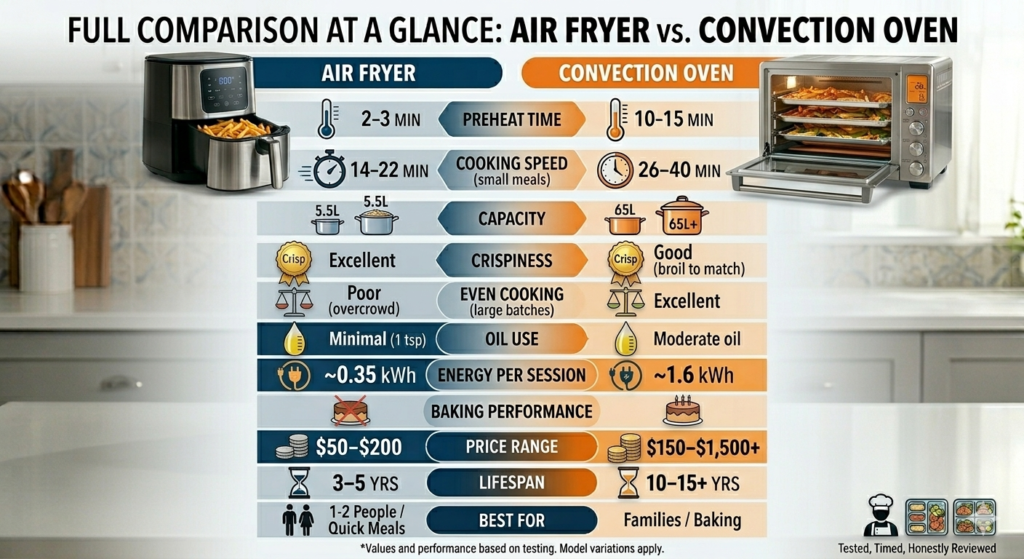
Full Comparison at a Glance
| Feature | Air Fryer | Convection Oven |
|---|---|---|
|
Preheat Time |
2 to 3 minutes |
10 to 15 minutes |
|
Cooking Speed (small meals) |
14 to 22 mins (Tested) |
26 to 40 mins (Tested) |
|
Capacity |
1.5L to 5.5L |
20L to 65L+ |
|
Crispiness |
Excellent |
Good (needs broil to match) |
|
Even Cooking (large batches) |
Poor if overcrowded |
Excellent |
|
Oil Use |
Minimal (1 tsp or less) |
Low moderate |
|
Energy per session |
0.35 kWh (15 min) |
1.6 kWh (40 min) |
|
Baking Performance |
Poor for large items |
Excellent |
|
Price Range |
$50 to $200 (Approx.) |
$150 to $1,500+ (Approx.) |
|
Lifespan |
3 to 5 years (heavy use) |
10 to 15+ years |
|
Best For |
1 to 2 people, quick meals |
Families, baking, batch cooking |
What Can You Actually Cook?
Air Fryer Best Use Cases
- Frozen foods: fries, nuggets, fish sticks fast and crispy
- Chicken wings, thighs, drumsticks excellent results in under 25 min
- Reheating leftovers: pizza, fried chicken way better than a microwave
- Small portions of roasted veg (under 300g)
- Bacon, sausages, breakfast items
- Small baked goods: cookies (small batch), muffins
Air Fryer Where It Fails
- Whole roasts or large cuts of meat does not fit or cooks unevenly
- Layer cakes, soufflés, macarons requires temperature precision it cannot deliver
- Cooking for 4+ people at the same time multiple batches kills the time advantage
- Wet batter foods (tempura, beer-battered fish) batter drips and burns
Convection Oven Best Use Cases
- Full roast chicken or a leg of lamb even cooking, right size
- Sheet pan dinners for 4 to 6 people cook everything at once
- Baking: bread, cakes, cookies in large batches
- Casseroles, lasagna, gratins
- Dehydrating: jerky, dried fruit on low temp settings
- Multiple dishes at the same time across different racks
Baking Test Chocolate Cake
We baked the same chocolate cake batter in both appliances at 180°C. Air fryer (6 inch pan): uneven rise, burnt edges, undercooked center. Not usable. Convection oven: even rise, properly baked in 28 minutes. Perfect. Verdict: Do not bake full cakes in an air fryer. It is not built for it.
Which One Fits Your Life?
Get the Air Fryer If:
- You cook for 1 to 2 people on weeknights
- You want fast, crispy food without much effort
- You have a small kitchen or limited counter space
- Your budget is under $100 and you need something now
- You eat a lot of frozen food and want it to taste better than microwaved
Get the Convection Oven If:
- You cook for a family (3+ people) regularly
- You bake bread, cakes, pastries even occasionally
- You do meal prep for the whole week in one session
- You want one appliance to do everything
- You have the counter space and a slightly higher budget
What If You Can Afford Both?
Many serious home cooks use both. The air fryer handles weeknight quick meals and reheating. The convection oven handles weekend cooking and anything larger. If your budget allows it, that combination covers almost every cooking scenario you will face.
Real Price Ranges (2026)
| Category | Air Fryer | Convection Oven |
|---|---|---|
|
Budget |
$50 to $80 (Cosori, CHEFMAN) |
$150 to $200 (Black + Decker, Cuisinart) |
|
Mid-range |
$100 to $150 (Ninja, Philips) |
$250 to $400 (Breville Smart Oven) |
|
Premium |
$180 to $250 (Ninja Foodi combos) |
$500 to $1,500+ (Wolf, built-ins) |
|
Lifespan |
3 to 5 years with daily use |
10 to 15+ years |
|
Long-term value |
Lower may replace sooner |
Higher buy once, use forever |
Note: Prices sourced from Amazon and retailer listings as of early 2026. Prices change always check current listings before buying.
→ For current air fryer deals and picks we recommend, visit our Best Air Fryers guide.
The Bottom Line
There is no objectively better appliance. There is only the right tool for your specific kitchen and cooking habits.
Final Verdict from HK Gadgets
Air fryer: Best for speed, crispiness, small kitchens, solo or couple cooking, and weeknight meals. Budget-friendly upfront. Convection oven: Best for families, baking, batch cooking, and long-term value. Costs more, does more, lasts longer. If you can only pick one: think about how many people you cook for. That single factor predicts the right choice more than anything else.
Ready to buy? Read our Best Air Fryers to Buy in 2026 tested picks across every budget. Or explore our Kitchen Gadgets hub for more comparison guides.
Frequently Asked Questions
These are the real questions people search. Straight answers, no fluff.
Is an air fryer just a small convection oven?
Technically similar, but not the same. Both circulate hot air with a fan, but an air fryer does it at much higher speed in a much smaller space. That concentrated airflow is what creates the deep-fry-like crispiness. A convection oven cannot replicate this on small foods without a broiler assist.
Can a convection oven replace an air fryer?
Partially. Many newer convection ovens include an ‘air fry’ mode that comes close, but it does not fully match a dedicated air fryer on crispiness or speed. If your convection oven has this mode and you mainly cook small batches, you might not need a separate air fryer.
Which uses more electricity air fryer or convection oven?
A convection oven uses significantly more electricity per session. A 1,400W air fryer running 15 minutes uses ~0.35 kWh. A 2,400W oven running 40 minutes uses ~1.6 kWh. Over a year of daily use, the air fryer could save you $50to$100+ in electricity depending on your rates.
Can I bake a cake in an air fryer?
Small single layer cakes in a 6 inch pan sometimes, with trial and error. Full size layer cakes, no. The uneven heat and small space cause burnt edges and undercooked centers. For baking, use a convection oven.
Is air fryer food actually healthier?
It uses up to 75% less oil than deep frying, which does reduce calorie and fat content. However, if you are cooking processed foods (frozen nuggets, fries), the sodium and additives are still there. Air frying is a healthier cooking method, not a health food machine.
Which is better for frozen food?
Air fryer by a wide margin. Frozen fries, nuggets, fish sticks, and similar foods come out crispier and faster in an air fryer than any oven setting. This is where air fryers genuinely outperform.
Which is better for meal prep?
Convection oven. You can cook large quantities across multiple trays at once. Air fryers require multiple batches for anything over 300 to 400g, which defeats the time-saving purpose of meal prep.
Can I use foil in both?
Yes, but with caution. In an air fryer, never cover the entire basket floor with foil it blocks airflow and ruins results (and can be a fire hazard). Use small pieces under food only. In a convection oven, foil on trays is generally safe.

Waqas Ramzan
I don't just research products — I buy and use them myself, then cross-reference my experience against thousands of verified customer reviews to find what brands won't tell you upfront. Most review sites test something for a week and move on. My process is different: real purchase, real use, real patterns pulled from hundreds of buyer reviews months after purchase — the complaints, the failures, the surprises that never appear in marketing copy. I'm here because bad purchasing decisions cost real money. My job is to make sure yours doesn't.