
Latest Posts
- 7 Best Wood Polish for Furniture in 2026 (That Real Users Actually Recommend)
- Best Wood Conditioners: Pre-Stain, Food-Safe and Furniture Picks (2026)
- Wood Conditioner vs Wood Polish: What’s the Difference and Which Do You Actually Need?
- Instant Pot vs Ninja Foodi: Which Multi Cooker Actually Wins in 2026?
- Best Budget Mini Electric Pressure Cookers for Students & Small Families (2026 Edition)
Other Categories
Wood Conditioner vs Wood Polish: What's the Difference and Which Do You Actually Need?

In this Article
Wood Conditioner vs Wood Polish — Direct Comparison
When You Need a Wood Conditioner?
What About Sanding Sealer vs Wood Conditioner?
Are There All-in-One Products That Condition and Polish Wood?
Can You Use Both Products? Yes — Here Is the Correct Order
Quick Answer: Wood conditioner penetrates inside wood fibers to moisturize, prep, and protect bare or dry wood — used before staining or on food-contact surfaces. Wood polish sits on top of an existing finish to restore shine and provide surface protection — used on already-finished furniture. They serve completely different purposes and are not interchangeable.
Most people grab wood polish when their wood actually needs a conditioner. Wrong product. Wrong result. Wasted money.
Here’s how to tell the difference — and pick the right one — in under 3 minutes.
What Is Wood Conditioner?
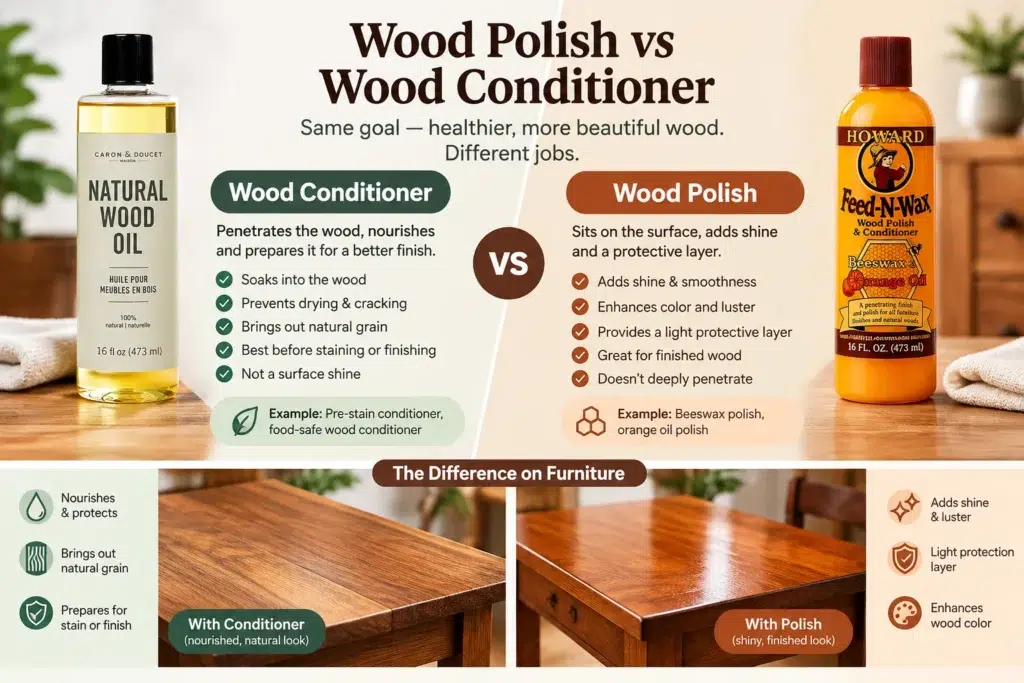
Wood conditioner is a liquid or oil-based treatment that penetrates inside wood fibers to moisturize, stabilize, and prepare wood from the inside out. It does not sit on the surface — it soaks in.
Wood conditioner is used to:
- Moisturize dry, cracked, or raw wood
- Prep bare wood before staining to prevent blotchy, uneven color absorption
- Protect food-contact surfaces like cutting boards and butcher blocks
- Revive wood that has lost its natural oils through age or climate exposure
Think of wood conditioner as a moisturizer for your skin — it feeds the material from the inside, not the surface.
Signs your wood needs conditioner:
- Looks grey, chalky, or dull despite being clean
- Feels rough even after sanding
- Small cracks or splits are forming
- Water no longer beads on the surface
You’re about to apply stain
What Is Wood Polish?
Wood polish is a surface treatment that sits on top of an existing wood finish to restore shine, fill light surface scratches, and add a thin protective layer against dust, fingerprints, and minor abrasion.
Wood polish is used to:
- Restore shine to dull, finished furniture
- Cover light surface scratches on lacquered or varnished wood
- Maintain antiques and dining tables
- Provide a protective barrier on already-finished surfaces
Think of wood polish as a surface treatment — it improves appearance and provides light protection, but it does not penetrate or repair the wood underneath.
Signs your wood needs polish:
- Surface looks flat or hazy but wood is structurally sound
- Already has a finish (lacquer, polyurethane, varnish, wax)
- Light scratches visible on the surface
- Furniture looks clean but lacks depth and shine
Wood Conditioner vs Wood Polish — Direct Comparison
| Feature | Wood Conditioner | Wood Polish |
|---|---|---|
|
Where it works |
Inside wood fiber |
On top of existing finish |
|
Best used |
Before staining / on bare wood |
On already-finished wood |
|
Primary purpose |
Moisture, prep, protection |
Shine, scratch cover, maintenance |
|
Penetrates wood? |
Yes |
No |
|
Food-safe options? |
Yes — mineral oil, beeswax blends |
Rarely |
|
Best for |
Cutting boards, raw wood, pre-stain |
Furniture, cabinets, antiques |
|
Application frequency |
Every few months or when wood looks dry |
Monthly or as needed |
|
Can it replace the other? |
No |
No |
When You Need a Wood Conditioner
Before Staining — Especially Softwoods
Pine, poplar, and maple are blotch-prone woods. Apply stain directly without conditioner and you will get dark patches, light patches, and uneven color that looks unprofessional.
Wood conditioner applied before stain partially seals the wood surface, slowing stain absorption and creating even, consistent color across the entire piece.
This step is not optional for pine. It is the difference between a professional result and a ruined project.
Cutting Boards and Food-Contact Surfaces
Any wood that contacts food needs a food-safe conditioner — not polish. Food-safe conditioners that meet FDA guidelines include:
- Mineral oil — most widely used, odorless, colorless, FDA-compliant
- Beeswax blends — adds a surface seal on top of oil conditioning
- Fractionated coconut oil — stable, does not go rancid
What to avoid on cutting boards: Olive oil, vegetable oil, and regular cooking oils go rancid inside the wood. Your cutting board will develop an unpleasant odor within weeks. Avoid any conditioner containing linseed oil or tung oil on food-contact surfaces.
Dry or Neglected Wood
Wood loses moisture over time — especially in dry climates, heated rooms, or air-conditioned environments. Conditioning at this stage stops further deterioration. Polishing at this stage does nothing — you would be shining a surface that is failing underneath
When You Need Wood Polish
Finished Furniture That Looks Dull
If your dining table, cabinet, or bookshelf has an existing finish — lacquer, polyurethane, oil finish, or wax — and looks dull or hazy, that is a polish job.
Polish removes surface oxidation and light scratches. It restores depth and shine without stripping or reapplying the original finish.
Antique Furniture Maintenance
Antiques require careful handling. Most professional restorers use silicone-free, beeswax-based polishes. Silicone builds up over time and makes future refinishing nearly impossible — a serious problem for valuable antique pieces.
Look for:
- Beeswax or carnauba wax base
- Silicone-free formula
- Compatible with aged or delicate finishes
Regular Surface Maintenance
If your wood furniture looks structurally fine but needs cleaning and a shine boost, that is polish territory. Monthly polishing on high-use surfaces like dining tables keeps them looking maintained and adds a thin protective barrier against everyday spills and light abrasion.
What About Sanding Sealer vs Wood Conditioner?
These two products are frequently confused. They are different products used at different project stages.
| Feature | Wood Conditioner | Sanding Sealer |
|---|---|---|
|
Purpose |
Even stain absorption |
Seal wood before topcoat |
|
Used before |
Stain |
Varnish or lacquer |
|
Effect on finish |
Slightly lightens color |
Builds a sealed base layer |
|
Best for |
Blotch prevention on bare wood |
Professional multi-coat finishing |
Simple rule: Staining the wood → use wood conditioner first. Applying a clear topcoat after staining → use sanding sealer between coats. They are used at different stages of the same project, not as substitutes for each other.
Are There All-in-One Products That Condition and Polish Wood?
Yes — combination products exist that both condition and polish wood in a single application. These are sometimes labeled as “wood conditioner and polish,” “feed and wax,” or “nourishing wood polish.”
How they work: The conditioning agents (typically mineral oil or beeswax) penetrate the wood surface to add moisture, while the polish components (carnauba wax, beeswax) seal and shine the surface simultaneously.
Best use cases for all-in-one products:
- Already-finished wood that is also showing signs of dryness
- Regular maintenance of oiled or wax-finished furniture
- Cutting boards with a wax-sealed surface (food-safe versions only)
Limitations to know:
- All-in-one products do not replace a dedicated conditioner for bare or pre-stain wood — the conditioning penetration is lighter than a standalone conditioner
- They do not work well on raw, unfinished wood before staining — you need a dedicated wood conditioner for that
- For heavily dried or cracked wood, a standalone conditioner applied first will always outperform an all-in-one
Recommended all-in-one products:
- Howard Feed-N-Wax — beeswax and orange oil blend, conditions and polishes finished wood
- Walrus Wood Wax and Board Cream — food-safe, conditions and seals cutting boards in one step
- Daddy Van’s Beeswax Polish — food-safe, conditions and protects antique and finished wood
For food-contact surfaces, only use all-in-one products that are explicitly labeled food-safe or FDA-compliant.
Can You Use Both Products? Yes — Here Is the Correct Order
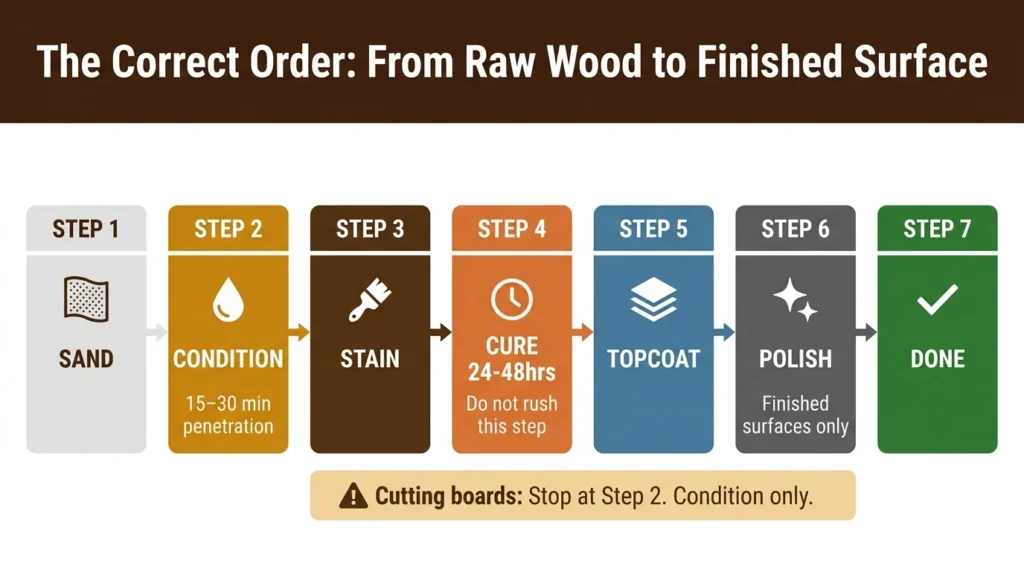
Wood conditioner and wood polish are not competitors. They work at different stages of the same workflow.
Correct sequence for a raw wood project:
- Sand the wood — start at 120 grit, finish at 220
- Apply wood conditioner and wipe off the excess: 5 to 15 minutes for oil-based, 1 to 5 minutes for water-based.
- Wipe off excess — do not allow pooling on the surface
- Apply stain within 2 hours — before conditioner fully dries
- Allow stain to cure — 24–48 hours minimum
- Apply topcoat — polyurethane, lacquer, or oil finish
- Maintain with wood polish — once finish is fully cured
For cutting boards specifically: Follow steps 1–3 only. Condition every 1–3 months. No stain. No topcoat. No polish unless it is a food-safe all-in-one product.
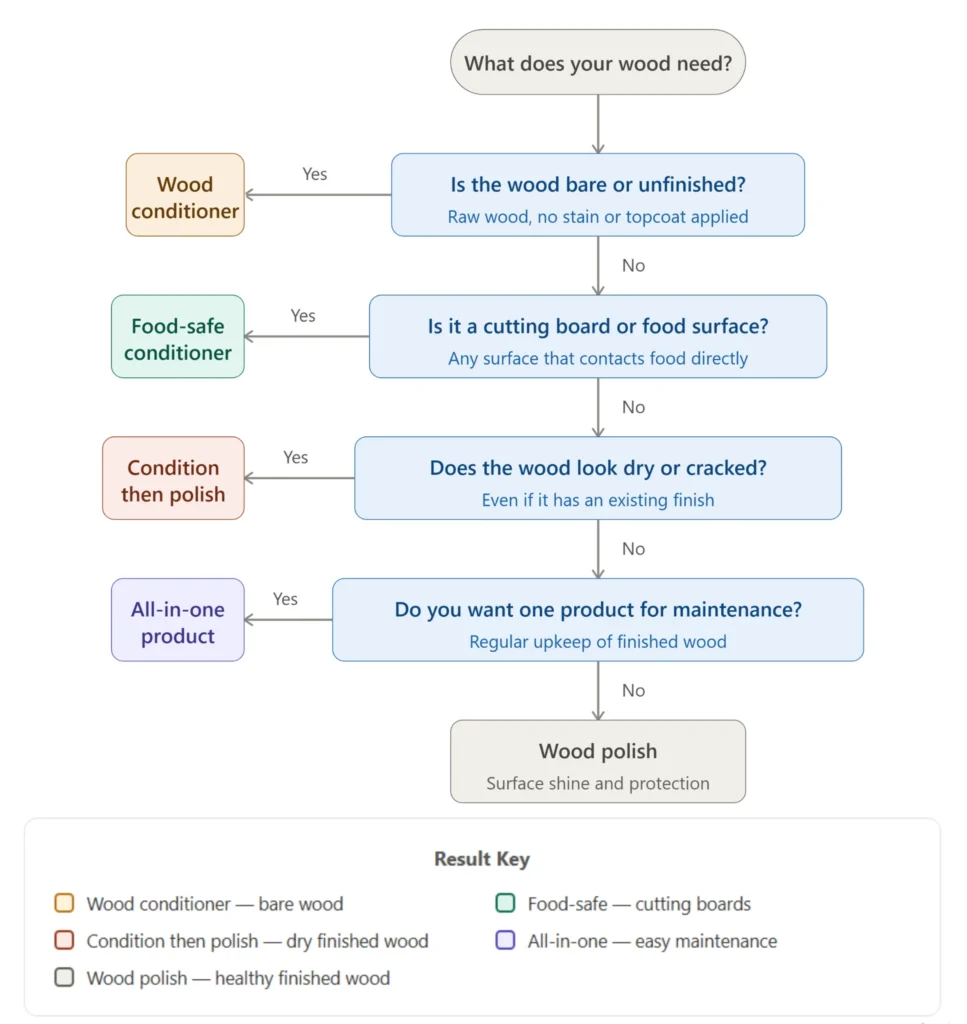
Which One Do You Actually Need? Quick Decision Guide
Answer these questions:
Is the wood bare or unfinished? → Yes = Wood conditioner
Are you about to stain the wood? → Yes = Wood conditioner first, then stain
Is it a cutting board or food-contact surface? → Yes = Food-safe wood conditioner only
Is the wood already finished and just looks dull? → Yes = Wood polish
Is the wood dry AND already finished? → Condition first, allow absorption, then polish the surface
Do you want one product for regular finished wood maintenance? → Yes = All-in-one conditioner and polish (see recommendations above)
HK Gadgets Recomendation
For cutting boards and food-safe conditioning: → Best Wood Conditioner for Cutting Boards — Food-Safe Only
For furniture polish and surface restoration: → Best Wood Polish for Furniture — Tested and Compared
Frequently Asked Questions
What is the difference between wood conditioner and wood polish?
Wood conditioner is a penetrating treatment that soaks into bare or dry wood to add moisture, prevent blotching before staining, and protect food-contact surfaces. Wood polish is a surface treatment applied to already-finished wood to restore shine, cover light scratches, and add a protective layer. They work at different stages of wood care and cannot replace each other.
Do I need wood conditioner before staining?
For softwoods — pine, poplar, birch, and maple — yes, wood conditioner before staining is strongly recommended. These woods absorb stain unevenly without pre-conditioning, resulting in blotchy, unprofessional color. For hardwoods like oak, conditioning is usually not needed, so test on a scrap piece first.
Is wood conditioner the same as wood polish?
No. Wood conditioner penetrates inside the wood fiber. Wood polish sits on top of an existing surface finish. Using polish on bare wood does nothing for moisture or stain preparation. Using conditioner on finished furniture will not add shine. They are not substitutes.
Can I use wood polish on unfinished wood?
Technically yes — but it is ineffective and potentially counterproductive. Polish formulated for finished surfaces will not penetrate raw wood. It may also interfere with stain absorption if you plan to stain the wood afterward. Always use wood conditioner on unfinished wood.
Are there all-in-one products that condition and polish wood?
Yes. Products like Howard Feed-N-Wax, Walrus Wood Wax and Board Cream, and Daddy Van’s Beeswax Polish combine conditioning and polishing in a single application. They work well for maintaining already-finished wood that is also showing minor dryness. However, they do not replace a dedicated standalone conditioner for bare wood before staining — the penetration depth is lighter. For food-contact surfaces like cutting boards, only use all-in-one products explicitly labeled food-safe or FDA-compliant.
What is the best wood conditioner for cutting boards?
Use only food-safe options. Howard Food Grade Mineral Oil is widely trusted — it is FDA-compliant, odorless, and colorless. Walrus Cutting Board Oil combines mineral oil, beeswax, fractionated coconut oil, and Vitamin E for deeper conditioning. Avoid any product containing linseed oil, tung oil, or unspecified additives on cutting boards. See our full cutting board conditioner guide for tested product recommendations.
How often should I condition or polish my wood?
- Cutting boards: Every 1–3 months, or when water no longer beads on the surface
- Raw wood before a project: Once, immediately before staining
- Finished furniture: Polish monthly for high-use pieces, every 3 months for low-use
- Antiques: Every 3–6 months with a silicone-free beeswax polish
For specific product recommendations based on your wood type and use case, see our tested guides: Best Wood Polish for Furniture | Best Wood Conditioner for Cutting Boards

Waqas Ramzan
I don't just research products — I buy and use them myself, then cross-reference my experience against thousands of verified customer reviews to find what brands won't tell you upfront. Most review sites test something for a week and move on. My process is different: real purchase, real use, real patterns pulled from hundreds of buyer reviews months after purchase — the complaints, the failures, the surprises that never appear in marketing copy. I'm here because bad purchasing decisions cost real money. My job is to make sure yours doesn't.